
When we take over a Google Ads account, we do not launch campaigns in the first week. We find out what is broken.
That distinction matters, because in most accounts the problem is not a missing campaign — it is that what already exists is measured wrongly. An account that looks healthy in the interface may be delivering nothing on the business side, and the reverse is just as true.
The list below is a summary of the audit we run, in order, on the accounts we take over You can work through your own account in the same order; we have explained what each item checks and why.
In this guide we cover:
- The four things we look for in the measurement layer
- The symptoms that show account structure is broken
- Keyword and negative list checks
- Bidding, budget and distribution checks
- The order in which audit findings should be fixed
At Brandaft, we are an Istanbul-based Google Ads agency. We do not use the audit as a sales device but as the roadmap for the first month: we hand over what we found in writing and set the order of fixes accordingly.
Why Every Audit Starts With Measurement
The first item in the sequence is always the same: is the conversion data correct?
The reason: a conversion counted wrongly corrupts every other number in the account. The bidding strategy optimises the wrong signal, budget drifts to the wrong campaign, and reporting makes the wrong campaign look successful.
We measured this on our own site. In GA4, form submission was marked as a key event and 146 submissions appeared over 28 days. Looking inside changed the picture: 113 of those came from a free tool inside the blog, while actual quote-form entries numbered 3.
In other words, the dashboard was showing forty times reality. In an account like that, discussing bidding strategy is pointless.
Which channel is actually paying off?
We measure the return of each channel separately and put your budget where it returns the most. A plan based on data, not luck.
LEARN MOREPart 1: Measurement and Structure Checks
The first eight items look at what the account can see and how it is organised.
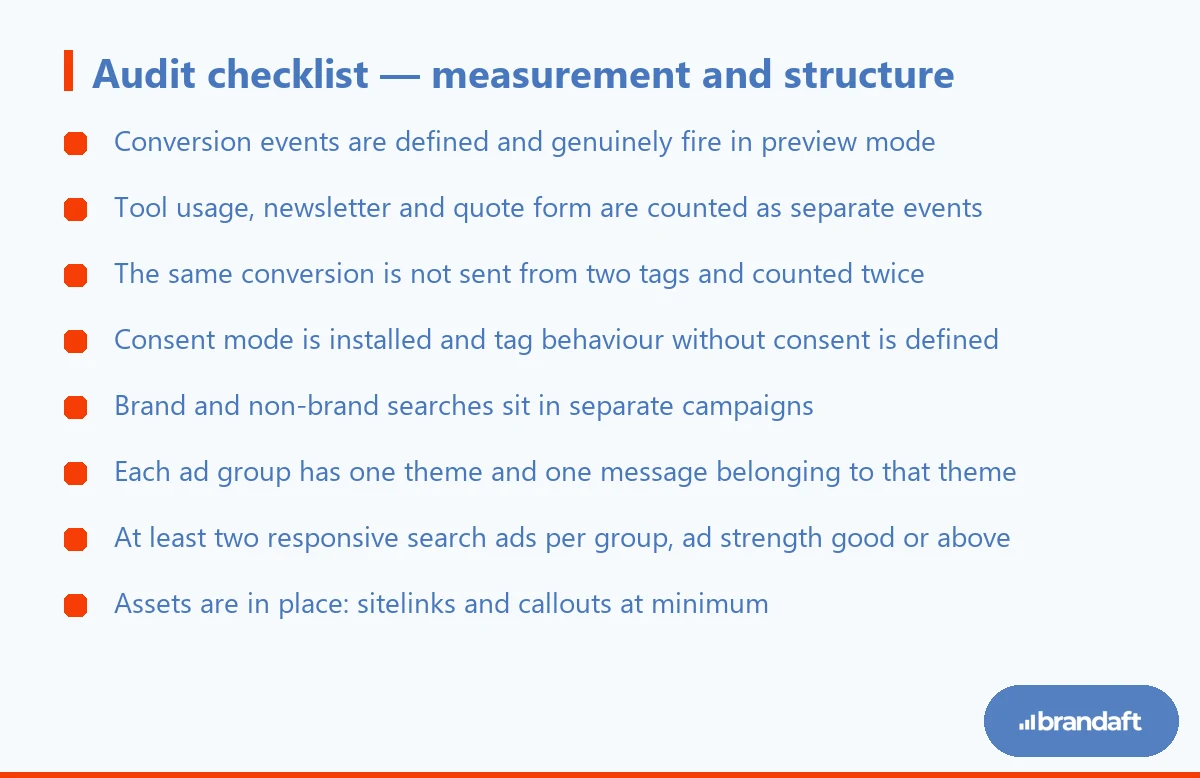
The second item is the one most often violated and the easiest to diagnose: if your conversion count is clearly higher than your sales count, more than one action is landing in the same bucket. Whether events are separated correctly should be checked on the GA4 conversion tracking GA4 conversion tracking side, and the firing conditions on the tag manager side.
The fifth item affects reporting directly. Brand searches are cheap and convert well; when they sit in the same place as non-brand campaigns, they make the account's real performance look better than it is.
The sixth and seventh items summarise the structural side. We set out how to build ad group architecture and how to write responsive ads in our Search Network setup guide in detail.

Part 2: Keyword, Bidding and Budget Checks
The remaining seven items look at where the budget goes.
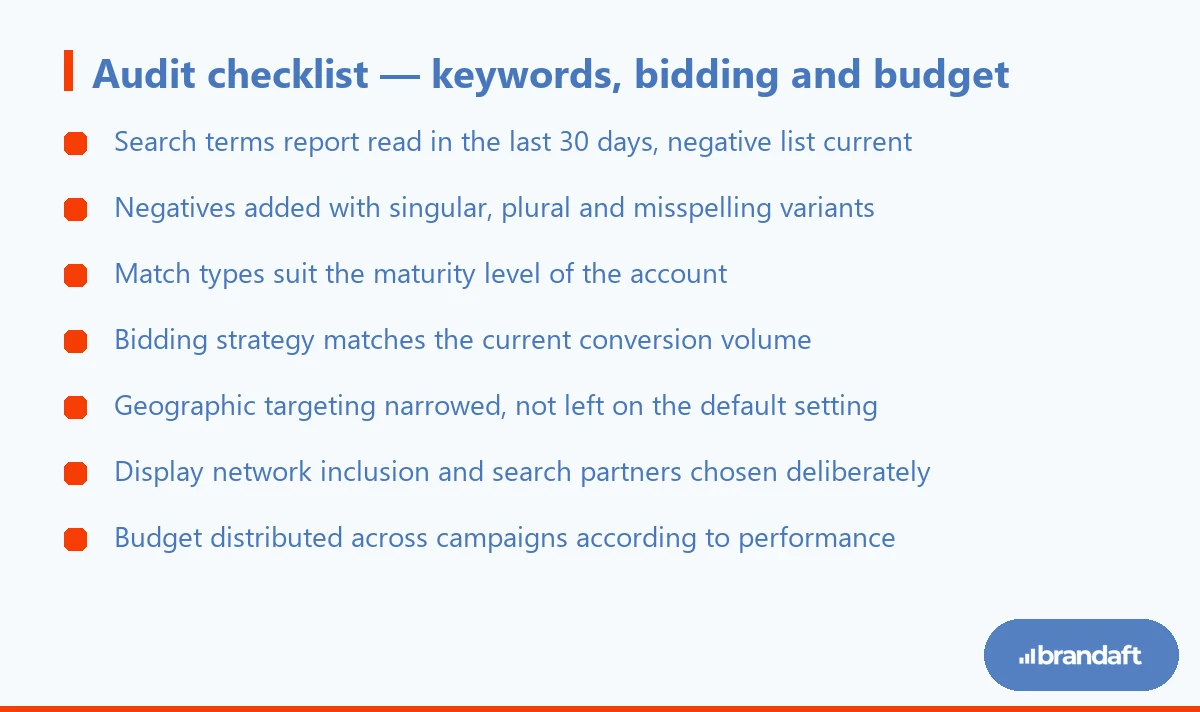
The second item is little known but loses budget directly: negative keywords do not match close variants. On the positive side Google covers singulars, plurals and misspellings for you; on the negative side it does not. We covered that distinction and how to layer the list in our guide to match types and negative keyword management there.
The fourth item is also often skipped. In a campaign with single-digit monthly conversions, smart bidding produces erratic results; we explained how to match the strategy to your data volume in our bidding strategies guide how to earn this.
The sixth item is the classic place where budget quietly evaporates in new accounts: you may think you opened a Search campaign while your ads are also showing on display inventory.
In What Order Should You Fix What You Find?
An audit usually produces ten to fifteen findings. Fixing them all at once makes it impossible to see what worked.
The order is: measurement first, then waste, then structure, and bidding last.
measurement comes first because every other decision rests on it. Waste is second because it pays back fastest: fixing the negative list and geographic targeting usually shows an effect within the same week. Structure is third, and its effect appears over a few weeks. Bidding is last; a bid change made before the first three are settled produces nothing but noise.
The most common reflex that breaks this order is applying the automatic recommendations shown in the interface. Google's recommendations optimise a single metric rather than the account as a whole; a recommendation applied while measurement is broken simply scales the breakage. We listed the other structural mistakes on the ads side in the most common Google Ads mistakes .
How Often Should the Audit Be Repeated?
A full audit twice a year is enough. But three items should be checked far more often.
The search terms report is read weekly in the first month and every two weeks after that. Conversion tracking is verified after every site update — a theme change, a form update or a new plugin can break the tags. Budget distribution is reviewed monthly.
When these three slip, the account degrades slowly, and the degradation is noticed not suddenly but over months.
An Audit Is Not a Report, It Is a Sequence
The value of a Google Ads audit lies not in how many findings it produces but in the order it puts them in.
A fifteen-point list gives you a photograph of the account. The real work is deciding what to fix first in that photograph — and in almost every account that decision starts in the same place: is the conversion the dashboard shows actually a conversion that brings business?
If your account has clicks but you cannot see the equivalent on the sales side, the first four items on this list probably contain the answer. If you would like to run the audit together, we can start with our free diagnostic report. free diagnostic report .
Frequently Asked Questions About Google Ads Account Audits
How do you audit a Google Ads account?
The audit runs through five headings: measurement, account structure, keywords and negatives, bidding strategy, budget distribution. The order matters — no assessment made before measurement is verified is reliable, because every other metric rests on conversion data. Tying each heading to a written list of what is checked makes the audit repeatable. The findings should then be grouped by fix order, not handled one by one.
What should you look at first in an audit?
Whether conversion tracking works correctly. If the conversion count in the interface is clearly higher than your sales or enquiry count, more than one action is landing in the same bucket: tool usage, newsletter sign-ups and quote forms have not been separated. In that situation there is no point discussing bidding strategy, budget or campaign structure; the counting has to be fixed first.
Should I apply the optimisations Google recommends in the interface?
Automatic recommendations are produced to optimise a single metric; they do not know your account as a whole or your business goal. A recommendation applied while your measurement is broken scales the breakage. Rather than applying recommendations wholesale, each one should be judged against your own audit order. Be particularly careful with budget increases, switching to broad match and automated asset suggestions.
How often should an audit be done?
A full audit twice a year is enough. But three items should be checked more often: the search terms report weekly in the first month and every two weeks after that; conversion tracking verified after every site update; budget distribution reviewed monthly. A theme change, a form update or a new plugin can break tags silently, and that kind of breakage is noticed months later.
What should the first fix after an audit target?
Measurement first, then waste, then structure, and bidding last. Fixing measurement sets the foundation for every other decision. Fixing waste — the negative list and geographic targeting — pays back fastest and usually shows an effect within the same week. Structural changes take a few weeks. Bidding strategy should not be changed until the first three are settled; otherwise you cannot tell which change produced which effect.
Should I audit my account myself or bring someone in?
You can audit your own account with this list; most items are checked with a few clicks in the interface. The advantage of an outside view is that it breaks familiarity blindness — questioning assumptions in a structure you built yourself is hard. The decision point is not "can I do this" but "do I have time to run these checks regularly". An audit is not a one-off job but a repeated discipline.