
Until a few years ago, the only way to find out which ads your competitors were running was to search repeatedly and note the ads down by hand.
Today Google and Meta publish that information themselves. The Google Ads Transparency Center keeps the ads of verified advertisers in a searchable archive; the Meta Ad Library does the same for its own platforms.
But access on its own is not an advantage. There is a serious difference between seeing a competitor's ad and understanding a competitor's strategy, and most teams open the tool with the wrong question.
In this guide we cover:
- Exactly what the Transparency Center shows
- What Makes the Meta Ad Library Different
- What These Tools Cannot Tell You
- Finding the gap instead of copying
- The rhythm the analysis should follow
At Brandaft, we are an Istanbul-based Google Ads agency. We use competitor analysis not as a first step in client accounts but as a check performed once our own data has settled. The reason: knowing what a competitor does is not a substitute for knowing what works for you.
What Does the Google Ads Transparency Center Show?
The Transparency Center is a searchable archive of the ads verified advertisers run across Google platforms. You can search by advertiser or site name and filter results by date and targeted region.
According to Google's own announcement, the tool gives three core pieces of information: the ads an advertiser has run, the regions they were shown in, and the date an ad last ran along with its format (Google Blog).
The verification programme is an important detail here. Google has required identity verification for advertisers since 2020, and the verified business name appears in the centre. So you can also see who stands behind the ad in front of you.
What Is It Actually Good For?
There are three concrete uses. The first is mapping messages: which promise competitors lead with, which objection they answer, which differentiator they use.
Which channel is actually paying off?
We measure the return of each channel separately and put your budget where it returns the most. A plan based on data, not luck.
LEARN MOREThe second is reading persistence. If an ad has been running for months it is probably working; an ad that ran for two weeks and was pulled was most likely tested and dropped. That is not performance data on its own, but it is a strong clue.
The third is format and region distribution: which channels the competitor invests in and which cities they appear in.
What Makes the Meta Ad Library Different
The archive on Meta's side is more detailed. It shows the creatives of ads running on Facebook and Instagram, their start date, and the number of variations within the same campaign.
Variation count is a particularly valuable signal. A brand running fifteen different visuals of the same message has a serious testing discipline. An account that has been running a single creative for months is usually not being managed at all.
Reading both platforms together also tells you where a competitor has shifted budget. A brand that is heavy on Google and thin on Meta is focused on capturing intent; the reverse means they are trying to create demand. We covered how those two approaches are built together in our article on the integrated management of SEO and Meta ads there.
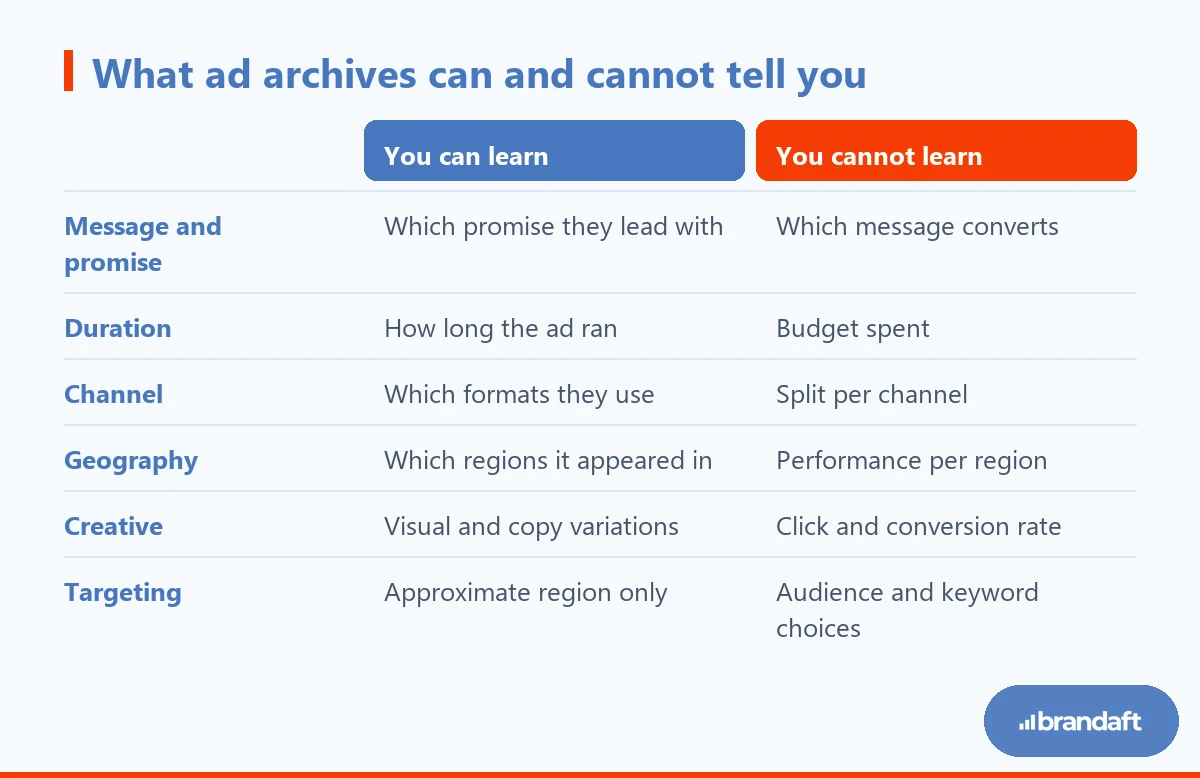
What These Tools Cannot Tell You
The most expensive mistake in competitor analysis is mistaking what you see for evidence.
Transparency tools do not give performance data. An ad appearing in the archive does not mean the ad worked. You cannot see budget, click-through rate, cost per conversion or profitability.
Targeting is invisible too. You cannot know which keywords a competitor bids on, which audiences they use, or what is on their negative list. The query you saw the ad on may not be the query they targeted.
The most dangerous inference is this: "if our competitor is doing it, it must be right." Your competitor may also be experimenting, may be getting it wrong, or may be working with a completely different margin structure. A copied campaign does not come with a copied cost structure.

Finding the Gap Instead of Copying
The value of competitor analysis is not in imitation but in finding what nobody is saying.
The practical method: put the ad copy of ten competitors side by side and group the promises. In most sectors the picture comes out surprisingly uniform — everyone says the same three things: fast delivery, competitive price, expert team.
That uniformity is your opportunity. If there is an objection nobody answers, a guarantee nobody offers or a cost item nobody talks about, that is where the distinctive line of your ad copy comes from.
The second method is looking for a channel gap. If every competitor has piled into search ads and nobody is running remarketing, there is an area where the same budget buys cheaper conversions. We covered how to make the channel decision in our campaign types guide there.
What Rhythm Should the Analysis Follow?
Competitor analysis is not a continuous job; done continuously, strategy turns into competitor-watching.
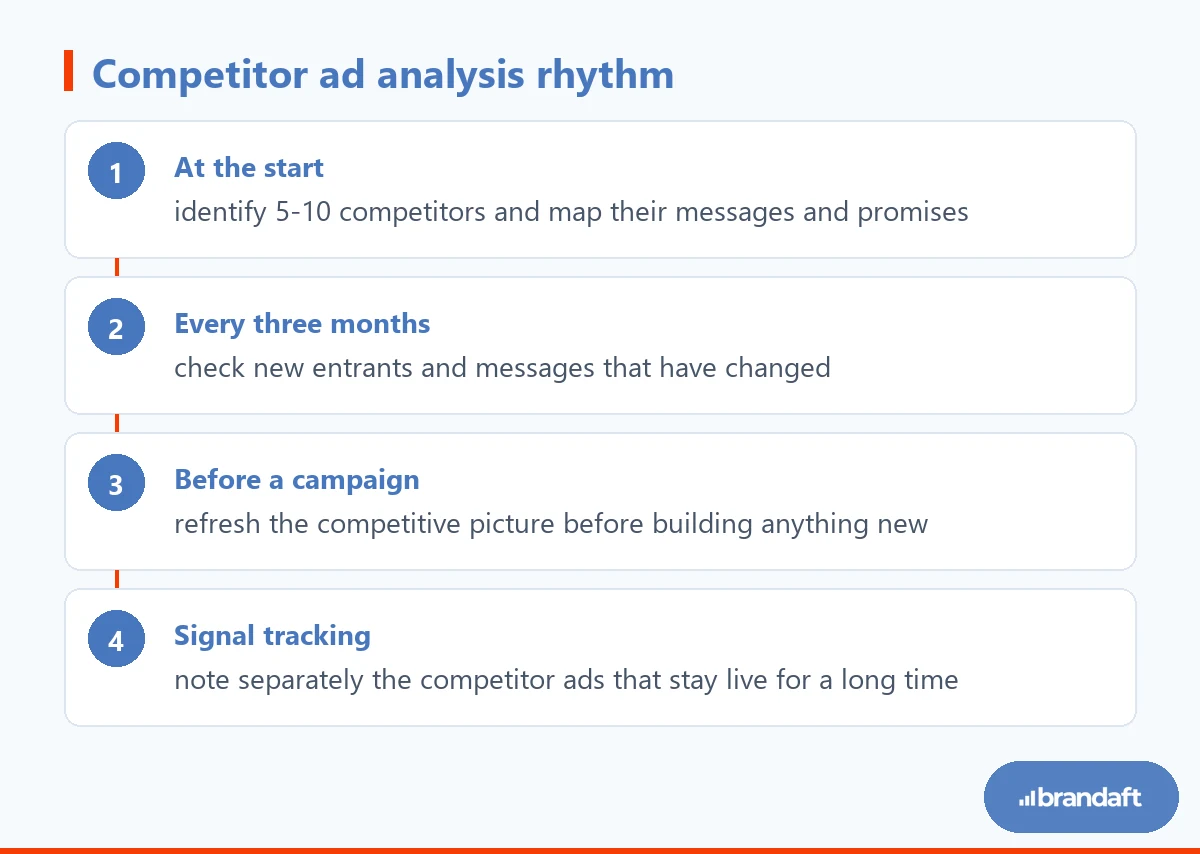
The fourth item is the most useful one. A competitor ad that has run unchanged for months is the strongest indirect signal that the message works. Do not copy it, but ask why it works: which objection does it answer, which fear does it remove?
The equivalent on your side is testing discipline. Hypotheses that come out of competitor analysis only gain value when they are measured in your own account; any comparison made without being sure measurement is set up correctly is misleading. Verifying whether conversion events genuinely count enquiries, on the GA4 conversion tracking GA4 conversion tracking side, is the first step.
Competitor Analysis Is a Check, Not a Strategy
Transparency tools gave marketers a field of view they had not had for a long time. But that field of view is not a substitute for your own data.
Knowing what a competitor does is meaningful after you know what works for you. When the order is reversed, what emerges is not strategy but imitation from behind.
If your ad copy cannot be told apart from your competitors', the problem is not budget but positioning. If you would like to review your current setup together, we can start with our free diagnostic report. free diagnostic report .
Frequently Asked Questions About Competitor Ad Analysis
How can I see my competitors' Google ads?
Through the Google Ads Transparency Center, by searching for the advertiser or the site name. You can filter results by date and targeted region, and see when an ad last ran and in which format it was shown. The centre covers verified advertisers only and also displays the verified business name. You can reach the tool directly in a browser; no Google Ads account is required.
Can I see a competitor's ad budget?
No. Transparency tools do not provide spend data; budget, click-through rate, cost per conversion and profitability are not visible in them. You can only learn which ad ran, when, and in which region. So seeing a large number of ads in the archive does not mean that brand works with a big budget — it may simply be testing many variations.
Does an ad running for a long time mean it performs well?
It is not conclusive proof, but it is a strong clue. In a managed account an ad that does not work is usually pulled; an ad that has stood unchanged for months either produces good results or the account is not being managed at all. To tell the difference, look at the brand's other ads: if they publish new creative regularly the account is managed, and the long-lived ad is a meaningful signal.
Can I find out my competitor's keywords?
Not from transparency tools; targeting information is not in these archives. Third-party SEO and ad tools offer estimates, but those are sample-based and not exact. The more reliable method is reading your own search terms report: there you see which queries you meet competitors on and what you pay on those queries. The auction insights report also shows who you compete with on the same query.
Is it right to copy competitor ads?
No, because what you see is the copy, not the result. Your competitor's margin structure, customer acquisition cost and bidding power may differ from yours; the same message can lose you money. The correct use of analysis is not imitation but finding the gap: when you place ten competitors' promises side by side, you usually find the same three things repeated. Your distinctive line comes from where nobody is speaking.
How often should competitor analysis be done?
Not continuously. Building a thorough message map for five to ten competitors at the start and refreshing it every three months is enough for most businesses. Beyond that, it is useful to look at the competitive picture before building a new campaign. Looking more often turns strategy into competitor-watching and cuts into the time you would spend learning from your own data.