
Match type is the best-known setting in Google Ads and the one whose function has changed the most.
Ten years ago exact match really was exact: your ad did not show unless the words you entered were searched verbatim. Today even exact match covers searches that carry "the same meaning or the same intent". Google widened match behaviour step by step, and that shift moved the centre of gravity of control.
Today the real lever is not the match type but how the negative list is built. It is also where budget quietly disappears in most accounts.
In this guide we cover:
- The syntax and the real behaviour of the three match types
- Why broad match is risky in new accounts
- How negatives work differently from positives, and the close variant trap
- The rhythm for reading the search terms report
- Layering the negative list at account, campaign and ad group level
At Brandaft, we are an Istanbul-based Google Ads agency. In the accounts we take over, the first week's work is usually not adding new keywords but removing the searches that should never have been there. A negative list looks like housekeeping; in fact it is what really decides who the campaign targets.
The Three Match Types and How They Actually Behave
Google defines three match types, each with its own syntax (Google Ads Help).Google Ads Help).
Broad Match
You enter the keyword as it is; this is the default type. Your ad can show on searches seen as related to your keyword — even when the keyword itself does not appear in the query.
The widest coverage and the lowest control. You are trusting Google's interpretation of relevance, and that interpretation is weak while your account has no conversion data.
Phrase Match
You put the keyword in quotation marks: "tennis shoes". The ad shows on searches that include the meaning of your keyword.
This is the middle path. The meaning is preserved but extra words can come before or after. A reasonable starting point for most accounts.
Exact Match
You put the keyword in square brackets: [red shoes]. The ad shows on searches that carry the same meaning or the same intent as your keyword.
Which channel is actually paying off?
We measure the return of each channel separately and put your budget where it returns the most. A plan based on data, not luck.
LEARN MOREThe most restrictive type: highest control, lowest volume. It is worth remembering that "exact" no longer means verbatim — synonyms and close variants come in here too.
Why Broad Match Is the Enemy of New Accounts
Broad match is not a bad type; it is an expensive one when used at the wrong stage.
The logic: Google looks at the conversion data in your account to predict which seemingly unrelated search is actually valuable. With no conversion data the prediction has nothing to stand on, and budget goes into exploration.
In a mature account, with a strong negative list and smart bidding, broad match genuinely finds new demand. In a new account it spends a large part of the first week's budget on "what is", "free" and "jobs" type searches. We set out what each data level allows in terms of bidding in our bidding strategies guide bidding strategies guide there; the match type decision sits on the same ladder.
Negative Keywords Work Differently From Positives
This is the part most guides skip, and skipping it shows up directly in the budget.
Negative keywords have broad, phrase and exact equivalents too. With negative broad match the ad does not show when all of the terms you specified appear in the search; with phrase match it is blocked when the terms appear in the same order; with exact match only that precise search is blocked (Google Ads Help).Google Ads Help).
The Close Variant Trap
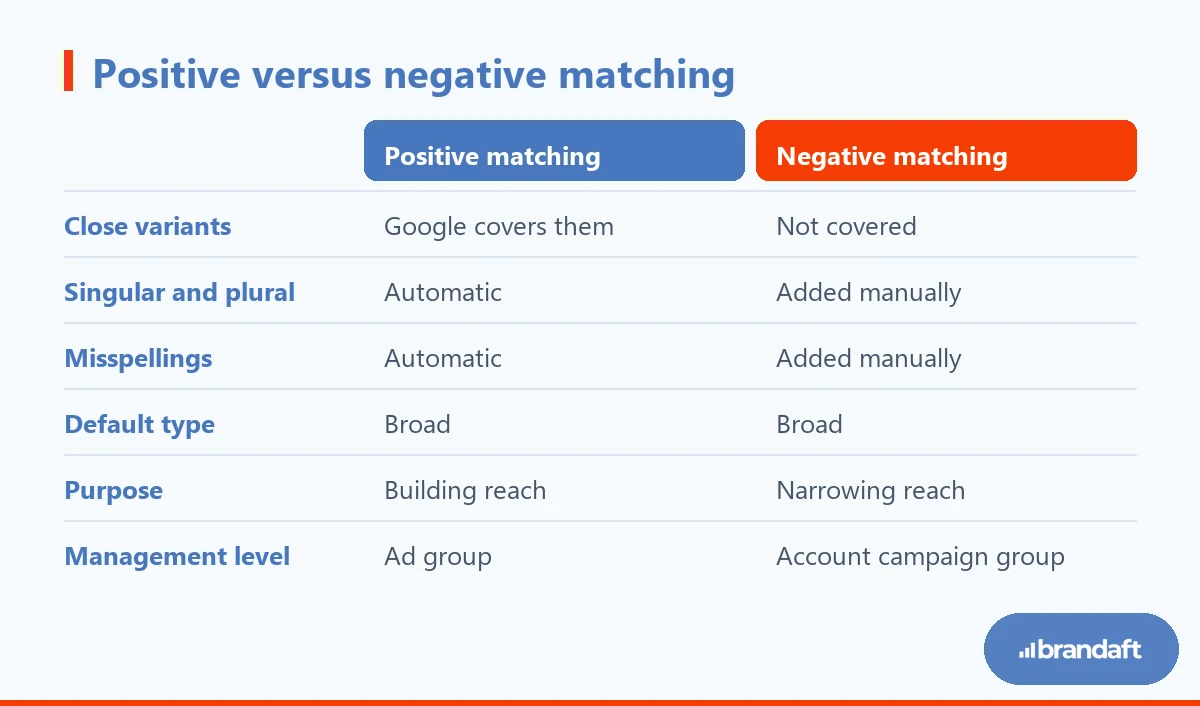
The critical difference: negative match types do not match close variants.
On the positive side Google covers singulars, plurals, misspellings and synonyms for you. On the negative side it does not. If you add "flowers" as a negative broad keyword, a search for "red flower" can still trigger your ad.
The practical consequence: negatives have to be added in singular and plural form, with common misspellings and with the word forms people actually type. "Free" on its own is not enough; "free", "freebie" and "no cost" may all be needed.
At Which Level Should They Be Added?
Account-level negative keyword lists apply automatically to all eligible campaigns and are managed from one place. Campaign and ad group level negatives work only within their own scope.
That distinction is also how you separate brand and non-brand campaigns: you add your brand terms as negatives in the non-brand campaign, so cheap brand traffic does not eat the competitive campaign's budget.
The Rhythm for Reading the Search Terms Report
The match type decision is made once; negative list management is continuous. The only thing that feeds it is the search terms report.
The report gives information in two directions. First, cleaning: searches that spend budget without intent. Second, opportunity: searches that convert well but are not in your keyword list. Moving the second into its own ad group raises relevance and conversion rate together.
A healthy rhythm: weekly in the first month, then every two weeks. Each reading both adds negatives and produces new keyword candidates. We explained how to separate which keywords actually turn a profit in our guide to profitable keyword selection there; this report is the raw material for that filtering.

Layering the Negative List
A single giant negative list becomes unmanageable. Building it in layers makes maintenance easier and prevents blocking good traffic by accident.
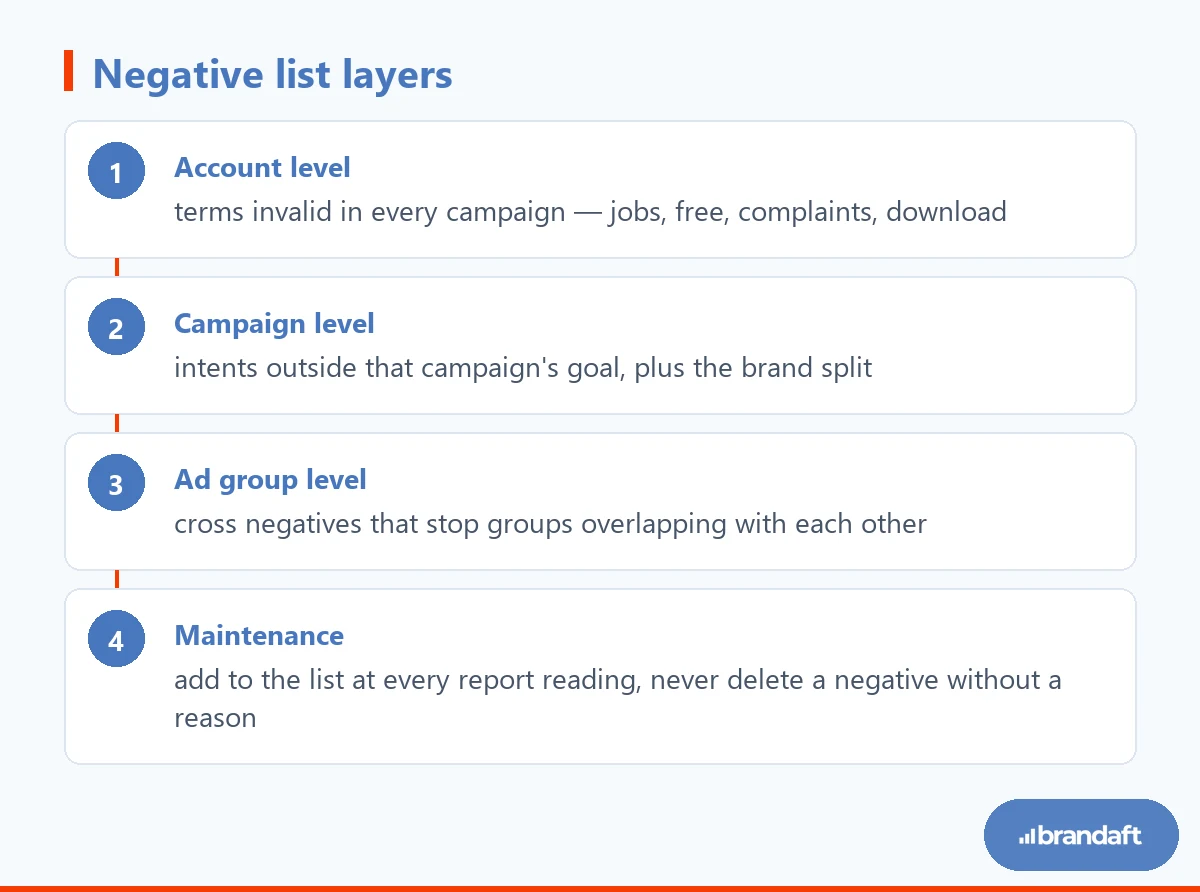
The third item is little known but important: if two ad groups in the same campaign match similar searches, which group shows which ad becomes unpredictable. Cross negatives prevent that overlap and let each group appear with its own message. We covered how to build ad group architecture in the Search Network setup guide. Search Network setup guide there.
The Four Most Common Mistakes
The mistakes we see in negative list management are not technical but habitual.
The first is building the list once and forgetting it. Search behaviour changes, new products appear, seasonal queries arrive; the list should be a living document.
The second is over-cleaning. Blocking a converting search by accident costs more than taking a few unnecessary clicks. Before adding a negative, check that term's conversion history.
The third is adding negatives with exact match only. You block one query while ten variations of the same intent keep coming through.
The fourth is never separating brand terms. This also corrupts reporting: brand effect and ad effect merge into one line and the campaign's real contribution cannot be measured. We listed the other structural problems on the ads side in the most common Google Ads mistakes. the most common Google Ads mistakes .
Control Is in the List, Not the Match Type
As Google has widened match behaviour, the weight of the question "which match type should I choose" has dropped.
The question that does the same job today is this: which searches do you not want to reach you, and how are you telling the system? Match type sets the width of the door; the negative list decides who walks through it.
If your account has plenty of clicks but no conversions, opening the search terms report and reading the last thirty days is the fastest diagnosis. If you would like to run that check together, we can start with our free diagnostic report. free diagnostic report .
Frequently Asked Questions About Match Types and Negative Keywords
Which match type should I start with?
For new campaigns, phrase match is a balanced start for most accounts: it preserves meaning, brings reasonable volume and leaves control with you. Starting with exact match can narrow volume too far, while starting with broad match spends budget on exploration when there is no conversion data. As data builds and the negative list strengthens, bringing broad match in under control makes sense. The decision depends less on the match type than on the maturity of the account.
Which match type should I use when adding negative keywords?
In most cases negative phrase match is a good default: it blocks searches containing the terms in order without shutting down individual words entirely. Negative exact match is used when you want to block one specific query only. Negative broad match is powerful but demands care; it can close off more searches than intended. Whichever type you choose, singular and plural forms have to be added separately.
Do negative keywords cover misspellings too?
No, they do not. While Google covers close variants, misspellings and singular-plural differences for you on positive keywords, that automatic expansion does not work on the negative side. Adding "flowers" as a negative can still leave "red flower" triggering the ad. That is why the negative list also needs common misspellings and singular-plural variations of each word.
How often should I read the search terms report?
Weekly in the first month is healthiest, because that is when the campaign matches the most irrelevant searches and loses budget fastest. After the first month, every two weeks is enough. Each reading does two jobs: searches that spend budget without intent are added as negatives, and searches that convert well but are not on the list are set aside as new keyword candidates. In an account where the report is never read, waste continues whatever the match type.
Should I use an account-level negative list?
Yes — it helps in any account with more than one campaign. Terms you never want in any campaign, such as jobs, free, download or complaints, are collected in a single account-level list and applied automatically to all eligible campaigns. That way you do not repeat the same cleaning for every new campaign. Intent distinctions specific to one campaign should stay at campaign level.
Should I make my brand terms negative?
In non-brand campaigns, yes. Brand searches are cheap and convert well; when they stay in the same campaign they fill the budget quickly and leave no room for competitive searches. Adding brand terms as negatives in non-brand campaigns and running brand in its own campaign gives you budget control and cleans up reporting. Without that separation, the campaign's real contribution cannot be measured.