
Bidding strategy is the most frequently changed setting in Google Ads and the least understood.
The reason it gets changed is usually the same: results come in below expectation, a "recommended" strategy appears in the interface, and it is switched with one click. Performance then drops for the first two weeks, so it is switched again. The account never finishes learning.
Smart bidding is not a bad choice. Early is what it can be. What makes the difference is not the strategy itself but whether your account has enough conversion data to feed it.
In this guide we cover:
- What question bidding strategies actually answer
- Where manual CPC still earns its place
- Smart bidding types and the data level each one needs
- What to do and not do during the learning period
- The Right Order for Moving Between Strategies
At Brandaft, we are an Istanbul-based Google Ads agency. When we take over an account we do not touch the bidding strategy on day one; first we check whether the conversion definition is correct. Smart bidding will optimise a badly defined conversion with exactly the same enthusiasm, and the result is a flawlessly managed wrong target.
What Question Does a Bidding Strategy Really Answer?
Every auction needs a bid. The question is: who decides that bid, and based on what?
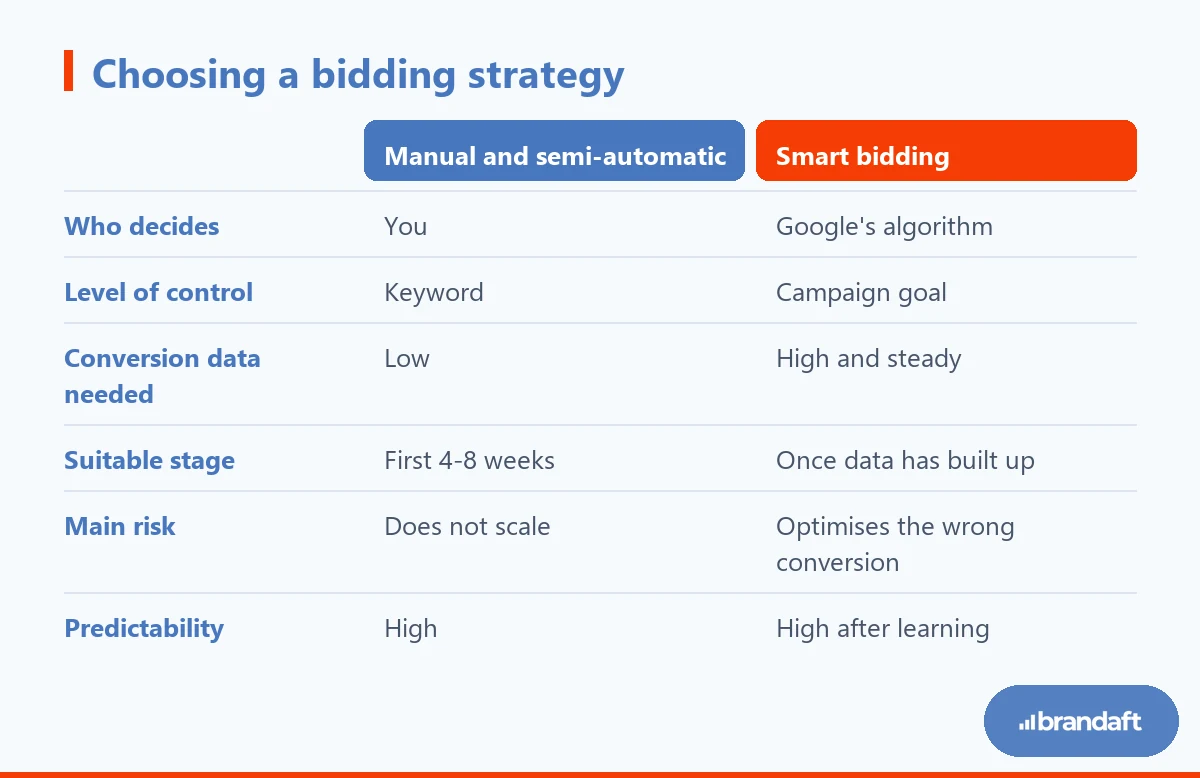
In a manual strategy you decide; you set a fixed ceiling at keyword level. In a smart strategy Google decides and calculates separately for every auction — using signals you cannot see, such as device, location, time of day, browsing history and the exact wording of the query.
That does not mean smart bidding is automatically superior. Google's signal advantage is real, but it learns what to optimise those signals towards from your conversion data. If the data is thin or wrong, the advantage turns into a disadvantage.
Does Manual CPC Still Work?
It does, but in a narrow band. Manual cost per click makes sense when you want keyword-level control and conversion data has not accumulated yet.
Which channel is actually paying off?
We measure the return of each channel separately and put your budget where it returns the most. A plan based on data, not luck.
LEARN MOREIts advantage is predictability: you know exactly what you pay for each keyword and you get no budget surprises. Its disadvantage is that it does not scale; managing bids by hand across hundreds of keywords takes time and keeps you from Google's real-time signals.
Google recommends click-focused strategies for new campaigns without enough conversion data (Google Ads HelpGoogle Ads Help). So a manual start is not a step backwards but a documented starting method.
Smart Bidding Types and What They Require
Google's conversion-focused smart bidding strategies fall into five headings. The difference between them is what they maximise and what they ask of you.
Maximise Conversions and Maximise Conversion Value
These two are built to spend your entire budget. You do not give a specific cost or revenue target; the system tries to get the most conversions, or the highest conversion value, with the budget provided.
They can be dangerous in accounts without budget discipline: if the daily budget is high, cost rises too, because budget is the only constraint. Moving to this strategy without working the budget back from a target leaves cost uncontrolled; we set out how to build that in our Google Ads budget article.
Target CPA and Target ROAS
With Target CPA you give a cost-per-action target and the system tries to hold that cost while increasing conversion count. With Target ROAS you give the revenue ratio you expect from ad spend and the system optimises conversion value.
Choosing between them depends on your business model. If every customer is worth roughly the same (service businesses, single-price products), Target CPA makes more sense. If basket value varies across a wide range (e-commerce), Target ROAS is the right tool. We covered the difference and when each one misleads in our ROAS versus CPA comparison there.
For Target ROAS to work at all, conversion value has to be sent to the platform. If no value is sent, the strategy appears to run but has nothing to optimise.
Enhanced CPC
Enhanced CPC is an optional feature used alongside manual bidding. You set the bid and Google adjusts it up or down in auctions where it sees a higher chance of conversion.
It is a reasonable intermediate step for accounts that do not want to move from manual control straight to full automation. You get part of the signal advantage without giving up control entirely.
The Learning Period: What to Do and What Not to Do
After every strategy change the campaign enters a learning period. Performance fluctuates during it, and the only correct behaviour is to wait.
What not to do is clear: changing the bid target, raising and lowering the budget, narrowing targeting, pausing and restarting the campaign. Each of these resets learning and starts the process over.
What you can do is not limited to watching without touching: adding negative keywords from the search terms report, improving ad copy and fixing the landing page do not disturb learning. Those improve the material you give the campaign, not the campaign itself.

The Right Order for Moving Between Strategies
A bidding strategy is not a list of options but a ladder. Skipping a rung is possible, but every skipped rung comes back as uncertainty at the next stage.
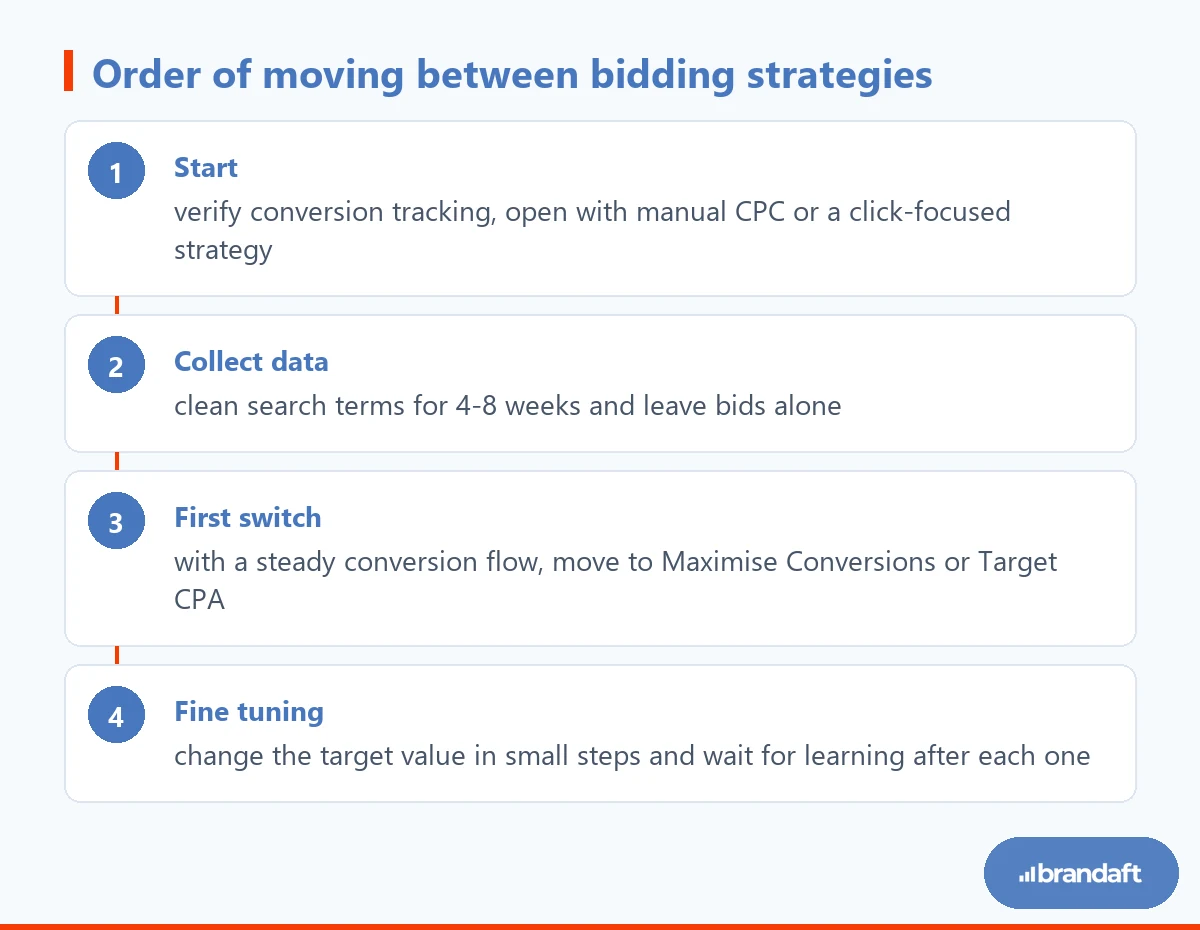
Changing the target value in large steps is one of the most common mistakes. Halving Target CPA does not halve cost; it cuts impressions and brings the campaign to a standstill. Changes should be made in steps of no more than twenty per cent, with learning allowed to complete after each one.
We listed the other structural mistakes on the ads side in the most common Google Ads mistakes the most common Google Ads mistakes article; bidding decisions make more sense read alongside that list.
Signal Quality Decides, Not the Strategy
The success of smart bidding depends less on the intelligence of the algorithm than on the accuracy of the signal you give it.
If your conversion events count real demand, smart bidding does its job well. If you put tool usage, newsletter sign-ups and quote forms in the same bucket, the algorithm will grow the campaign that brings you the most newsletter sign-ups — and it will do it with flawless efficiency. Verifying whether events genuinely count demand, on the GA4 conversion tracking GA4 conversion tracking side, comes before any bidding decision.
If results swing every time you change strategy but stability never arrives, the problem is most likely not in bidding but in measurement. If you would like to look at your current setup together, we can start with our free diagnostic report. free diagnostic report .
Frequently Asked Questions About Google Ads Bidding Strategies
Which bidding strategy should I start with?
In a new account there is no conversion data, so starting with a click-focused or manual strategy is correct; Google recommends the same for campaigns without enough data. The aim at this stage is not to achieve the lowest cost but to learn which queries convert. Cleaning up search terms for four to eight weeks and building the negative list first before moving to smart bidding produces much healthier results. Switching early forces the algorithm to learn without data.
How many conversions does smart bidding need?
Google does not publish an official floor, but the strategy needs a steady flow to find patterns. In practice, a campaign with single-digit monthly conversions gets erratic results from smart bidding. Consistency matters as much as the total: a campaign receiving a similar number of conversions each week learns far better than one that gets a batch once a month. If data is insufficient, it is the conversion definition that should be reviewed, not the strategy.
Should I use Target CPA or Target ROAS?
If value per customer is roughly similar, Target CPA is more suitable; service businesses and single-price products fall into this group. If basket value varies across a wide range, Target ROAS is the right tool, because the system aims at valuable conversions rather than cheap ones. But for Target ROAS to work, conversion value has to be sent to the platform. If no value is sent, the strategy appears to run but has nothing to optimise on.
How long does the learning period last?
Usually between one and two weeks, but the duration is set by conversion volume, not the calendar. A campaign with many weekly conversions settles in a few days, while the process takes longer in a low-volume campaign. Changing the bid target, budget or targeting during this period resets learning and the clock starts again. Impatience is the most expensive decision made during a learning period.
Does changing the bidding strategy delete historical data?
The campaign's historical performance data is not deleted and continues to appear in reports. However, the new strategy does not inherit the optimisation history of the previous one; it goes through its own learning process from the start. That is why accounts that change strategy often stay permanently in learning and never see the true performance of any strategy. If a change is to be made, the reason should be clear and enough time allowed to see the result.
Is manual bidding completely obsolete now?
No, but its range has narrowed. Manual CPC still makes sense for a controlled start on new campaigns and for predictability in accounts with very limited budgets. On the other hand, managing bids by hand in accounts with hundreds of keywords and many campaigns takes time and keeps you from Google's real-time signals. If you want a middle path, Enhanced CPC alongside manual bidding is a reasonable rung.