“Our rankings are fine, but traffic is dropping. Did we get a penalty?”
Most of the time, no. The most common cause of this pattern is zero-click search — when a user gets the answer on Google’s results page and ends the search without clicking any website. We’re talking about search behavior and its impact on SEO here, not the “zero-click attack” concept from cybersecurity.
The numbers show this behavior is no longer the exception. According to SparkToro’s measurement based on Similarweb panel data, in the first four months of 2026, 68.01% of Google searches in the US ended without a single click; in 2024 the figure was 60.45% (SparkToro, 2026). In Pew Research Center’s study based on real browser data, users clicked on a result in 8% of visits when an AI summary appeared; for searches without a summary, that figure was 15% (Pew Research Center, 2025). For Turkey, the key date is clear as well: AI Overviews and AI Mode became available on February 18, 2026 in Turkey (Google Turkey, 2026).
At Brandaft, we are an Istanbul-based, measurement-driven GEO agency. Our position on this is clear: we treat zero-click not as a disaster scenario, but as a signal to renew the measurement model. Clicks may decline. But visibility that isn’t measured properly means demand lost without anyone noticing.
In this guide, we’ll cover:
- What zero-click search actually is
- Why it has accelerated over the last two years, and what Google says about it
- Which content is affected more, and which less
- How to measure the impact in your own Search Console data
- Which metrics to track success with as clicks decline
- A checklist you can save
What Is Zero-Click Search? (Not a Single Box, but a Page Design)
A zero-click search is a search where the answer is given directly on the results page and the user leaves without clicking any organic or paid result. No single feature keeps the answer on the page; featured snippets, knowledge panels, the “People also ask” box, map results, calculators and, most recently, AI Overviews all do the same job in different ways.
There is also a second, less visible type: the user clicks, but stays inside Google through Maps, YouTube or a new search. For Google, that’s engagement; for you, it isn’t a visitor. That’s why the 7.2-point rise in the re-search rate over two years in SparkToro’s study matters.
Rankings can hold. / Clicks can go elsewhere.
Reading a traffic drop without making this distinction means getting the diagnosis wrong from the start. So why has this behavior accelerated now?
Why Has Zero-Click Search Accelerated? (What Did AI Overviews Change?)
Zero-click search isn’t a new concept. What has changed is the size of the answer: it used to be a paragraph taken from a single page; today it’s a summary compiled from several sources, with small source links underneath. SparkToro reports that when AI summaries appear, click-through rate drops by about 60% and that these summaries appear in more than 20% of searches.
Pew’s finding shows the other side of the story. In the same study, users clicked the source link inside the summary in only 1% of visits, and among searches starting with question words such as “who”, “what”, “when” and “why”, 60% produced an AI summary. In other words, the most affected area is exactly the question-style queries that information sites depend on.
Is AI citing you as a source?
Get your brand named in ChatGPT, Perplexity and Google AI answers. We find where your visibility breaks down and fix it.
REQUEST A GEO ANALYSISGoogle disputes this picture. According to Liz Reid, head of Google Search, the total volume of organic clicks from Google to websites has been “relatively stable” year over year, and quality clicks, where users don’t quickly bounce back, have increased slightly (Google, 2025). The same post also acknowledges that traffic has fallen for some sites and risen for others, with forums, videos, original first-hand experiences and in-depth analysis gaining.
Both sides can be right at the same time: the total can stay flat while the distribution shifts. The real question isn’t “are clicks declining?” but “what’s happening to my queries?”
How Does Zero-Click Search Affect Your Traffic? (Not Every Query Loses the Same)
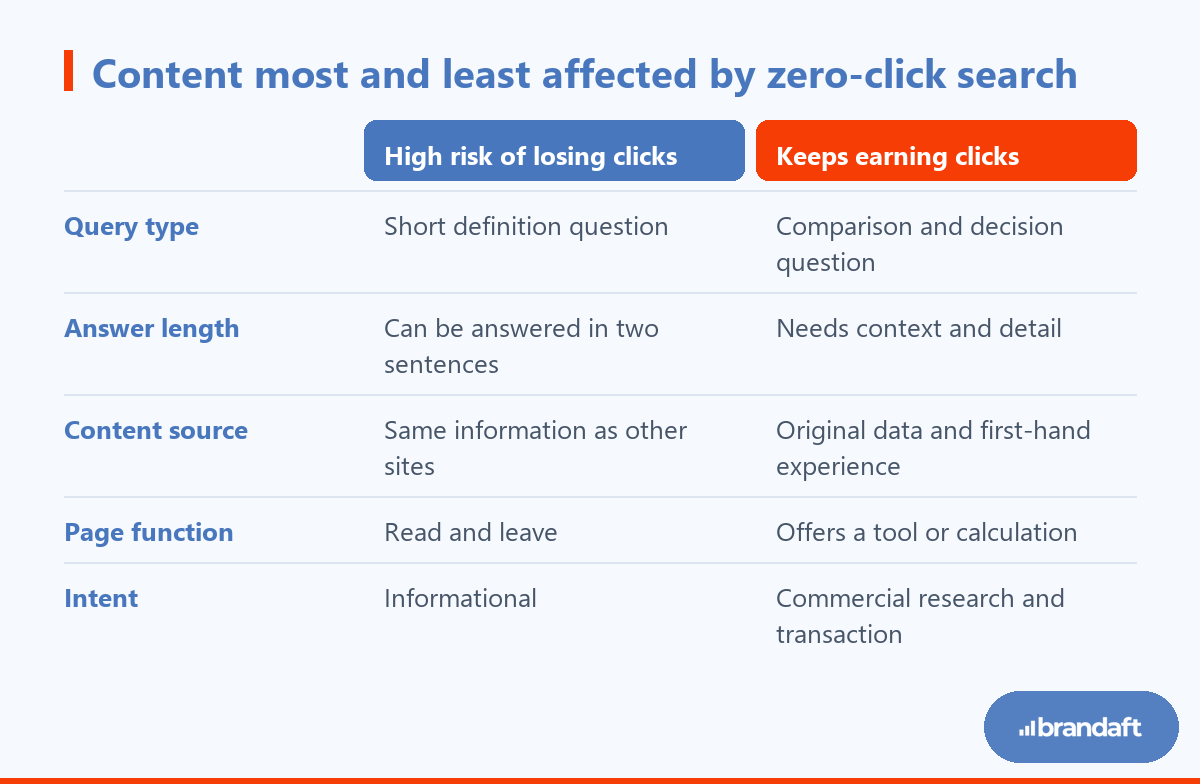
Zero-click search doesn’t hit all content equally. What decides it isn’t the quality of the content, but the type of answer. An answer that fits in two sentences stays on the results page; a need that requires a decision, a comparison, experience or a transaction still earns clicks.
The click you lose on a definition query was often a visitor who was nowhere near a purchase decision. If the same drop shows up in the commercial queries of one of your service pages, though, it carries a very different level of urgency. The search intent distinction becomes the first filter of measurement here.
You need to find where the impact is with data, not guesswork.
How Do You Measure Zero-Click Impact in Search Console? (A 4-Step Diagnosis)
Google states that click, impression and position data for pages appearing in AI Overviews and AI Mode are included in the “Web” search type of the Search Console Performance report (Google Search Central). So for the initial diagnosis, Google Search Console yeterli.
1. Compare the right periods. Choose the periods before and after AI Overviews launched in your market (in Turkey, February 18, 2026), ideally as two periods of the same length. Comparing the last 28 days with the previous 28 days is misleading; choose periods of at least three months each.
2. Look for the zero-click signature. The signature is this: average position stays the same or improves, impressions rise, and clicks and click-through rate fall. In a ranking drop, position worsens too; with zero-click, it doesn’t. This distinction answers the question “did we get a penalty?”

Let us share our own data as an example. When we compared the period from November 1, 2025 to January 31, 2026 with June 1 to August 31, 2026 on brandaft.com, impressions rose from 211,539 to 285,323 and average position moved from 18.8 to 17.4 — an improvement. Clicks, however, fell from 2,795 to 2,122 and click-through rate dropped from 1.32% to 0.74% (Search Console, 2026). This is a raw comparison that new content and seasonality also influenced; it isn’t proof of causation. But it matches the zero-click signature exactly, not the penalty pattern.
3. Separate question-style queries. In the query filter, look at patterns such as “what is”, “how” and “why” as a separate segment and compare click-through rates within the same position range. In our data (where the equivalents were the Turkish “nedir”, “nasıl” and “neden”), the click-through rate of question-style queries in the top three positions fell from 4.11% to 0.30% between the two periods. The sample is small, but the direction matches Pew’s finding.
4. Track AI visibility separately. In June 2026, Google announced that it had added reports to Search Console that show visibility in generative AI features separately (Google Search Central Blog, 2026). For now, the reports only provide impressions, pages, countries, devices and dates — no queries or clicks — and are rolling out to a group of sites first. If they appear in your account, use them to track which of your pages show up in AI summaries.
The diagnosis tells you where you’re losing. What you measure success with is a separate decision.
How Do You Measure Success Without Clicks? (Traffic ≠ Demand)
The most expensive mistake in the zero-click era is still tying reporting only to organic sessions. If a user got the answer from your content, they’ve had contact with your brand; the fact that it doesn’t appear in the report doesn’t erase that contact.
Impressions are visibility. / Clicks are only one part of that visibility.
We recommend building your measurement dashboard in four layers:
- Visibility: Impressions and position by query cluster; impressions in AI summaries, if available.
- Being cited: How often your brand and pages are mentioned in AI answers. We explain in our LLM citation guide how to earn this.
- Brand demand: Users who get to know you through zero-click often search for your brand directly later. That’s why branded search volume is the most concrete indirect indicator of visibility; how to increase branded search is covered in a separate article.
- Qualified demand: Forms, calls, WhatsApp and quote requests. Add the AI assistant channel in GA4 here as well; in our own data, this channel brought 111 sessions over the last 90 days (GA4, September 2026). It’s a small number, but it isn’t zero, and it’s growing.
The full KPI set is in the guide where we explain how to measure GEO success in detail. So what should you do once you’ve measured it?
What Should You Do in the Zero-Click Era? (A System, Not a List of Tactics)
Tactics like “let’s make the title more intriguing” offer short-term relief but don’t solve the problem. The solution is to reorganize your content portfolio around three roles.
Content that answers: let it be the source. For definition queries, the goal isn’t the click, but to be the source of the summary. According to Google, to be a supporting link in AI Overviews a page only needs to be indexed and eligible for a snippet; there’s no additional technical requirement. A clear definition, verifiable data and a clear structure are the foundation.
Content that earns the click: let it give what the summary can’t. Original data, field experience, comparisons and tools can’t be consumed on the results page. For example, a tool such as a rank checker answers the question “where does my site rank?” on the site, not on the results page.
The page that captures demand: let it meet transactional intent. Service, pricing and quote pages speak to users in the decision stage; those users still need to visit a website. The internal link path from informational content to these pages is the bridge that turns visibility into demand. In the age of AI, SEO isn’t ending; the way it’s measured is changing.
Zero-Click Checklist (Save It)
- [ ] Two equal-length periods before and after AI Overviews launched in your market were compared in Search Console
- [ ] Pages that kept their position but lost click-through rate were listed
- [ ] Question-style queries were reviewed as a separate segment
- [ ] Queries losing clicks were split by informational and commercial intent
- [ ] Impressions in the AI performance report, if available, are tracked monthly
- [ ] Branded search volume is reported as a separate KPI
- [ ] The AI assistant channel and qualified leads are tracked in GA4
- [ ] Definition content was updated to be clear, sourced and structured
- [ ] At least one piece of content with original data, a tool or first-hand experience is planned
- [ ] An internal link path from informational content to service pages is in place
Frequently Asked Questions About Zero-Click Search
What does zero-click search mean?
Zero-click search is when a user finds the information they’re looking for on the search results page and ends the search without clicking any website. Features such as featured snippets, knowledge panels, map results and AI Overviews give the answer directly on the page. A “zero-click attack” in cybersecurity, on the other hand, describes malware that gets into a device without any user interaction and is a completely separate concept. In an SEO context, the topic is always search behavior.
My rankings didn’t drop but my traffic fell — did I get a penalty?
Most likely not. If your average position in Search Console is holding or improving and your impressions are rising while your click-through rate falls, the pattern points to zero-click impact, not a penalty. With a penalty or an algorithmic loss, position also worsens noticeably. Still, a definitive diagnosis requires a period comparison at the query and page level.
What percentage of Google searches end without a click?
According to SparkToro’s measurement based on Similarweb panel data, 68.01% of Google searches in the US ended without a click in the first four months of 2026. In 2024, the figure was 60.45%. The study doesn’t cover Google’s mobile app and relies on panel data, so it’s better to look at the direction than at the decimals. There is currently no published measurement of similar scope for Turkey.
What does it take to be cited in AI Overviews?
According to Google, a page only needs to be indexed and eligible to be shown with a snippet in search results; there is no additional technical requirement. In practice, content that answers clearly and directly, relies on verifiable data and is well structured stands out. Being cited doesn’t guarantee a click, but it puts your brand inside the answer. That’s why visibility needs to be tracked as a separate metric alongside clicks.
Will zero-click search kill SEO?
No, but it changes how success is measured. Click loss on short-answer queries may be permanent; queries with decision, comparison and transactional intent, on the other hand, still send traffic to websites. Google also says total organic click volume has remained relatively stable and that traffic is shifting from some sites to those offering original, in-depth content. The goal of SEO shouldn’t be traffic alone, but turning visibility into qualified demand.
Which tools are enough to measure zero-click impact?
Google Search Console and GA4 are enough for the initial diagnosis. In Search Console, you track period comparisons, query segments and the AI performance report if available; in GA4, the AI assistant channel and qualified conversions. Additional monitoring may be needed to see how often your brand is mentioned in AI answers. What matters isn’t the number of tools, but reading this data together in the same report.
Conclusion: Clicks May Decline, but Demand Doesn’t Have to Disappear
Zero-click search broke the model that treats traffic as the only measure of success. Losing clicks while your rankings hold doesn’t mean the work was wasted; it means part of your visibility is happening outside your reports.
The right question isn’t “how do we win back clicks?” but “for which queries should we be the source, for which should we earn the click, and for which should we capture demand?” When you make this distinction with data, zero-click stops being a loss report and becomes a prioritization tool.
If you’d like to see together where zero-click impact starts in your site’s Search Console data, the first meeting is free: contact us for a free GEO analysis.