
Most global SaaS companies aren’t failing at SEO.
They’re measuring the wrong thing.
The charts are going up.
Traffic is growing.
There’s global visibility.
But at the same time, these questions are sitting on the table:
- Why isn’t ARR growing at the same pace?
- Why isn’t organic visibility turning into pipeline?
- Why is “relevant” traffic coming in but not making decisions?
This isn’t an SEO management problem. It’s a positioning and expectations problem.
Today, the SaaS market is on a trajectory expected to take it from its 2024 size of $317 billion to, by 2032, more than $1.2 trillion in size. Competition isn’t just increasing; it’s intensifying. At the same time, by 2026, more than 80% of companies will be actively using AI-powered applications.
These two realities mean that SEO’s playing field is fundamentally changing.
Users no longer click through to websites with every question. AI Overviews and large language models (LLMs) answer, compare and even recommend. The result?
There’s SEO traffic, but the moment of decision happens off the site. In other words, there’s traffic but no sales.
We’ve seen this picture clearly, both at a global scale and while working with local SaaS companies. As the
Brandaft SEO agency team, we have experienced time and again that projects aimed solely at rankings and traffic growth systematically hit a wall on the growth side.
Because in 2026, the problem with SEO is no longer this:
“Where do we rank on Google?”
The real problem is this:
- How is search demand being captured?
- At the moment of decision, how is trust being built?
- When it comes to the SaaS company’s growth model, does SEO actually serve it?
That’s why this playbook wasn’t written to answer the question “Should we do SEO?”
That question is already outdated.
This guide’s starting point is clear:
In 2026, SEO is not a ranking problem; it’s a problem of capturing demand and building trust.
And the right SEO strategy for SaaS companies only works when it’s approached together with the growth model.
Where Does SEO Fit in the SaaS Growth Cycle?
In most SaaS companies, SEO is positioned in just one place:
“Traffic acquisition.”
This is the easiest-to-measure but weakest definition of SEO.
Because SaaS growth isn’t a single line.
It starts with the product, deepens with trust, accelerates with sales and gains meaning through recurring revenue.
In this cycle, SEO plays a different role at every stage — but only when it’s used in the right place, with the right intent.
The problem is this:
- Many teams expect results from SEO without first clarifying their growth model.
- A Product-Led SaaS produces content like a Sales-Led one.
- A Sales-Led SaaS drowns in feature pages like a PLG one.
In the end, SEO seems to work, but it doesn’t serve growth.
Working with global and local SaaS companies, we’ve seen one thing clearly: SEO’s impact comes down to which growth model it serves and not to how much content gets produced. That’s why in this section we won’t treat SEO as a single “channel.”
How SEO differs
- in product discovery
- at the moment of decision
- in building trust before the sale
is what we’ll clearly break down.
Because the critical insight is this: the same anahtar kelime strategy doesn’t produce the same result across different SaaS growth models.
| Growth Model | SEO’s Primary Role | Most Effective Page/Content Types | The “Job” at the Moment of Decision | What Happens If It’s Set Up Wrong? | The Right KPI Logic |
|---|---|---|---|---|---|
| Product-Led Growth (PLG) | Self-serve decision support | Use-case content, problem-solution pages, features explained in context | Accelerating the “I’d use this” moment (reducing uncertainty about setup/value) | Early/excessive programmatic → low-LTV “just trying it” users | Activation, time-to-value, trial→paid conversion |
| Sales-Led | Building pre-sales trust and laying the groundwork | Comparison, alternatives, use-case, compliance/trust pages | Softening objections, answering “Is this company worth taking seriously?” | Squeezing SEO into a lead form → content doesn’t drive decisions, the sales cycle gets longer | Sales cycle length, close rate, pipeline impact (assisted) |
| Hybrid | Multiple roles by funnel stage (architectural approach) | Self-serve pages for PLG + trust/comparison pages for Sales-Led | Supporting the same intent along different decision paths (self-serve + sales) | One-size-fits-all content → one side gets stronger while the other weakens | Segment-based KPIs: self-serve conversion + sales impact together |
Now let’s look at where SEO sits within the three core SaaS growth models.
Product-Led Growth (PLG) SaaS SEO
In the Product-Led Growth model, SEO’s role isn’t to steer users toward a form.
Here, SaaS SEO lays the groundwork for the first contact with the product.
In PLG SaaS, growth doesn’t come from a sales conversation; it comes from the “I’d use this” moment users experience when they try the product. That’s why SEO’s job isn’t to describe features but to clarify what problem the product solves in the real world, and how.
Because users don’t come to Google with product features.
In the GEO era, searches are more specific, more contextual and more problem-focused. People ask:
- “Why does this process take so long?”
- “How can I do this with fewer people?”
- “Which tool actually lowers costs?”
Successful PLG SEO answers these questions in the user’s language rather than the product’s. Features only gain meaning within a use case. Otherwise, no matter how good the product is, SEO content stays abstract.
At this point, SEO plays three core roles for PLG SaaS companies:
- Feature discovery: Helping users connect capabilities that already exist in the product, but that they haven’t noticed yet, to their own problem
- Use-case clarification: Answering not “What does this product do?” but “Which part of my work does it make easier?”
- Self-serve decision support: Speeding up how the mental decision takes shape, without a demo request or a sales call
Well-structured PLG SEO pages look like blog posts, but they function as an extension of the product experience in practice. Before users even try the product, the uncertainties in their minds diminish. Questions about setup, value and use cases don’t go unanswered.
The biggest risk at this stage, however, is scaling SEO the wrong way.
In PLG SaaS, early and excessive programmatic SEO, more often than not, generates low-LTV traffic. Hundreds of pages go live and traffic grows, but these users don’t use the product in depth. Because the content is disconnected from real decision intent. It pulls the product out of the context of its value proposition and attracts “just trying it” users.
In the end, the problem isn’t SEO; it’s timing.
In PLG models, SaaS SEO is:
- Premature if applied before product–problem fit is clear,
- Harmful if scaled before features are matched with real use cases,
- A powerful lever if structured around the right intents once the value proposition is clear.
What we see in the field is very clear — and among the examples that illustrate it best, Vidlo stood out.
Vidlo is a social proof tool focused on video testimonials for SaaS companies, founded by a San Francisco–based woman entrepreneur. When the project came to us, there was a classic problem:
Whatever keywords the competitors were going after, and however they were doing it, the same path had been followed. A lot of content had been produced, but the content was generic. There were features, there were pages, there was traffic — but there was no clear story of what made it different.
We didn’t kick things off with an SEO checklist; we started with the right questions instead.
The critical questions we asked the founder in our first meeting were:
- At what point do you set yourselves apart from competitors?
- Why do customers find you “easy” or “convincing”?
- In practice, which decision do video testimonials speed up?
These answers took Vidlo’s value proposition out of the abstract. They clarified where the product is used, which process it simplifies and why it’s chosen.
We restructured SEO not around a feature list but around real usage scenarios and decision moments from the ground up. We supported the content with good storytelling. In the end, SEO stopped being a traffic machine for Vidlo and started working like a self-serve decision support layer from then on.
Rather than describing the resulting picture in words, the screenshot below says it all:
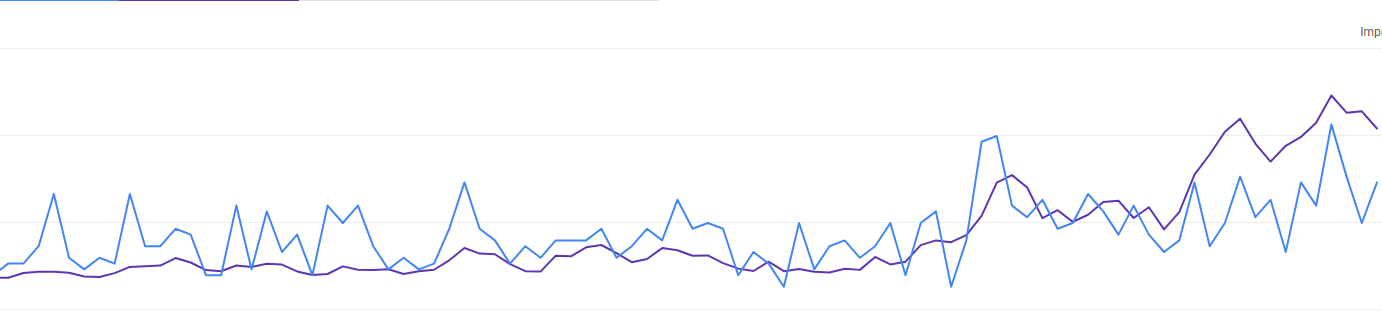
While designing this process, we didn’t ignore the marketing of the new era either. From a GEO perspective, we thought about how and where LLMs could reference Vidlo in their answers. To that end, guest authorship on trusted authorities across the internet earned us natural backlinks, which opened the door not only to SEO but also to LLM visibility.
Because GEO has changed the rules; in this era, the point is this: it’s not whoever has the most content, but whoever explains its difference most consistently that LLMs choose.
And this example showed us once again: in PLG SaaS, what matters for SEO success, it turns out, isn’t how many pages get produced; how clearly it’s explained what problem the product solves, in what context and for whom is the real measure.
In the GEO era, this clarity is no longer optional — it’s a prerequisite for growth.
SEO in Sales-Led SaaS
SEO’s role in Sales-Led SaaS is often misunderstood.
Here, SaaS SEO is set up like a “lead machine”: bring in traffic, get forms filled, start the sales conversation.
Are you getting traffic, or customers?
We build SEO around revenue, not rankings. Let’s find where your site is losing and prioritise fixes by impact.
GET AN SEO QUOTEBut in practice, this model rarely works.
In Sales-Led SaaS, the purchase decision isn’t made by one person in a single session. There are multiple stakeholders, perceived risk is high, and the decision process naturally begins with skepticism. That’s why SEO’s job isn’t to rush users toward a form but, before the sales conversation even starts, to prepare the ground.
In this model, SEO is strongest in these areas:
- Problem awareness: Framing the user’s problem correctly, naming it and giving the sense that “you’re not alone”
- Comparison & alternatives: Pages where competitors and alternatives are discussed openly — not hidden, but put in context
- Trust layer: Content that answers “Is this company worth taking seriously?” before any contact with the sales team
The value of Sales-Led SEO can’t be measured directly.
Because this content often doesn’t generate leads — but it speeds up how quickly leads close.
In real life, we often see this:
During a sales call, a prospect references a comparison page, a use-case piece or an “alternatives” article they found through SEO. These pages didn’t get them to fill out a form, but they quietly steered the decision process.
That’s why the critical distinction in Sales-Led SaaS is this:
SEO ≠ getting lead forms filled out
SEO = laying the groundwork for the sales conversation
A well-structured Sales-Led SEO strategy:
- Explains in advance the core arguments the sales team would otherwise have to make
- Softens most objections before the sales call even begins
- Answers “Why should I choose you?” not in the brand’s own words, but through logic and evidence
Here, SEO doesn’t try to persuade. It makes the environment where persuasion happens safe.
And here’s the most critical point: in Sales-Led SaaS, SEO success isn’t about how many forms get filled out; how much shorter and easier the sales process becomes is the real measure.
Hybrid SaaS Models
From an SEO perspective, Hybrid SaaS models are the most complex, but when set up correctly, the most efficient structures. Because in this model, growth doesn’t come from a single path. Some users try the product on their own, while others move forward by talking to the sales team. Both PLG and Sales-Led dynamics operate at the same time in the same product.
The problem is this:
Many Hybrid SaaS companies try to pick a single path in SEO as well.
Either they act fully like PLG, talking only about features and use cases.
Or they act fully like Sales-Led, loading everything onto comparison and decision pages.
In Hybrid models, however, SEO’s strength lies in its ability to take on different roles at different points in the funnel above all.
Here, SEO does three jobs at once:
- Users who want to try the product on their own get self-serve decision support from it
- Teams making bigger, riskier decisions get a trust and comparison layer built for them
- For users entering the sales process, it handles pre-persuasion and objection softening as a core task
That’s why a one-size-fits-all SEO strategy doesn’t work for Hybrid SaaS. The same keyword serves a different function at different points in the funnel.
An “alternatives” page can speed up product trials on the PLG side, while the same page can make it easier to start a sales conversation on the Sales-Led side. But these two roles can’t be carried successfully by the same content structure.
The clear truth we see in the field is this: in Hybrid SaaS, SEO doesn’t create value when it’s handled with channel logic; approaching it with growth architecture logic is what unlocks its value.
And this brings us to the main insight of this section:
The same keyword strategy doesn’t produce the same result in Product-Led, Sales-Led and Hybrid SaaS models.
Before asking “Which keyword should we target?”, positioning SEO correctly requires asking
“Which decision does this keyword influence in our growth model?” as the first question.
The Real Game in Global SaaS SEO: Intent > Keyword
Global SEO’da the biggest misconception is still this:
If we find the right keyword, we’ll get the right result.
Yet today, especially on the SaaS SEO side, the rules of the game have changed.
The winners aren’t the ones going after the most-searched keywords; they’re the ones who read the intent at the moment of decision correctly.
Because in global SaaS, SEO’s real value isn’t found at TOFU; BOFU is where it emerges.
| Intent Layer | Example Query Patterns | Best-Fit Page Type | The User’s Hidden Question | Required Trust/Proof | Success Signal |
|---|---|---|---|---|---|
| Problem Awareness (TOFU) | “why…”, “how to…”, “what causes…”, “process slow…” | Problem-solution content that answers directly | “Am I understanding the problem correctly?” | Clear framework + example scenarios (entity enrichment) | Quality: scroll/engagement, repeat visits, internal link clicks |
| Use-Case Clarification (MOFU) | “for teams”, “use case”, “workflow”, “best way to…” | Use-case pages / solution scenarios / features in context | “Will this fit my work?” | Real implementation examples, short customer stories | Demo/trial clicks, pricing views, moving on to product pages |
| Decision Comparison (BOFU) | “X vs Y”, “alternative to X”, “competitors”, “compare…” | Comparison & alternatives pages | “Am I going to make the wrong choice?” | Video testimonials / proof blocks / a clear differentiation story | Moving on to pricing, the form becoming the “last step,” a shorter sales cycle |
| Risk Reduction (BOFU) | “is it worth it”, “reviews”, “case study”, “security”, “GDPR compliant” | Trust pages (security/compliance), a proof layer before pricing | “Am I taking a risk with this company?” | 3rd-party references + customer experience (especially real user language) | Fewer objections, higher close rate, assisted conversions |
| Purchase Readiness (Decision) | “pricing”, “plans”, “demo”, “trial”, “implementation” | Pricing + onboarding/implementation pages | “Is it clear? How will the process work?” | Clear process, clear refund/cancellation terms, short video proof, FAQ | Demo/trial conversion, lead quality, time-to-close |
BOFU-Focused Search Intents: Where the Decision Is Searched For
Queries like “Alternative to X”, “X vs Y” or “Is [tool] worth it?” aren’t classic SEO content.
These are the moments when users have already built a shortlist and are closest to a purchase decision in their buying journey.
Pages like these:
- Clarify the options in the user’s mind
- Lower perceived risk
- Answer the question “Am I going to make the wrong choice?”
That’s why these pages are built not to bring in traffic, but to speed up decisions — that’s how their role should be defined.
From an SEO perspective, they look like content; functionally, however, they’re the anteroom to the sale.
And there’s a critical truth:
These pages don’t work without a trust layer.
Why Doesn’t BOFU Work Without Trust?
BOFU users aren’t open to being persuaded. They already arrive skeptical.
We’re in an era where AI-assisted content has exploded. Anyone can write “best software.”
The result? An abundance of text, an erosion of trust.
Users are now trying to figure out:
- Does this actually work?
- Is anyone actually using it?
- Has a team like mine made this decision?
At this point, a simple but harsh truth comes into play:
Text ≠ proof
That’s why, on BOFU pages, the fate of SaaS SEO is decided less by copy than by proof today.
How Does Social Proof Speed Up Decisions?
At this point, Vidlo Vidlo offers a very instructive case from our experience. We’ve been working together for about 9 months now, and we’ve seen a clear impact, especially on BOFU pages.
On comparison, alternatives and pre-pricing pages, we placed video testimonials in which real users describe their real experiences.
The results were striking:
- Average lead closing time dropped from 10 days to 5.5 days as a result
- In other words, a lead that comes in on Monday often buys by Friday
- Sales calls got shorter and objections decreased
This impact didn’t come from better-written SEO copy. People persuading other people is where it came from.
We observed the same thing again and again: users read the comparison page, move on to pricing, watch the video testimonial and make a decision. Filling out the form stops being a “beginning” and becomes the final step in the process.
That’s why the main idea of this section needs to be stated plainly:
SEO pages don’t persuade. People do.
And in global SaaS SEO, especially at the BOFU stage, the winners don’t optimize keywords; it’s decision psychology that they optimize.
Programmatic SEO: When Does It Drive Growth, and When Does It Just Inflate?
Programmatic SEO is one of the most misunderstood tactics of recent years in the SaaS world. Applied correctly, it’s a growth lever. Applied at the wrong stage, however, it only produces noise.
The problem isn’t the tactic itself, but when and why it’s used.
Many SaaS companies position programmatic SEO as an “accelerator” at an early stage. Hundreds or even thousands of pages go live, traffic rises quickly and at first glance everything seems fine. But a few months later, the same question lands on the table:
“Why isn’t this traffic turning into sales?”
The answer is usually painful: because the visibility problem, not the growth problem, is what programmatic SEO solves.
Scenarios Where Programmatic SEO Works for SaaS
Programmatic SEO isn’t right for every SaaS. But when used under the right conditions, it genuinely drives growth.
It generally works in these scenarios:
- A clear category definition exists and the product can easily be positioned within a specific class
- Search queries show high pattern repetition in the form of similar intents and similar variations
- The purchase decision is largely associated with the feature set and functional needs in the buyer’s mind
In this type of SaaS, users know what they’re looking for.
The answer to “Does software X do job Y?” is usually a matter of technical adequacy. Here, programmatic SEO speeds up the decision process and works like a scalable distribution channel.
But this picture doesn’t apply to most SaaS companies.
Scenarios Where Programmatic SEO Hurts SaaS
Programmatic SEO applied in the wrong context doesn’t grow a SaaS company; it inflates it.
It creates serious risk, especially in these situations:
- PLG + low switching cost models: it generates superficial traffic
- Complex pricing structures: it creates the wrong expectations
- In B2B SaaS where trust is critical, it weakens the decision process
In products like these, users don’t just ask “Does it have the feature?”
They ask questions like “Is this the right solution for me?”, “Is this a team we can work with?” and “Am I taking a risk?”
Programmatic SEO, however, often can’t answer these questions. Worse still, it generates traffic in which these questions are never asked at all.
In the end, dashboards fill up and charts climb, but LTV drops, churn rises, and instead of growth, SEO turns into an operational burden over time.
That’s why this point needs to be underlined in bold:
If programmatic SEO is applied at the wrong stage, it doesn’t grow a SaaS company; it inflates it.
The real leverage comes from treating programmatic SEO not as a “first move” but, once product–problem fit is clear and the trust layer has been built, as a scaling tool and using it that way.
And in global SaaS SEO, true mastery comes from knowing not which tactic to apply, but when to apply it, above all.
Localization ≠ Translation: The Heart of Global SEO
One of the most expensive mistakes in global SaaS SEO is seeing localization as mere translation and nothing more.
Translating text is easy. Translating intent is hard.
Because users in different countries don’t search for the same product; they experience the same problem in different contexts.
And SEO’s job isn’t to carry words over, but to localize the decision context.
That’s why we won’t talk about hreflang in this section.
As for the real difference, how search intent shifts from market to market is where it begins.
Market-Based Differences in Search Intent
The same SaaS product is met with completely different questions in different markets.
Global SEO strategies that ignore this difference usually end up “a little visible everywhere, but strong nowhere.”
To sketch a general framework:
- US market: Users compare quickly, want to see alternatives openly and ask the ROI question early. “X vs Y”, “alternative to X” and “is it worth it?” queries dominate.
- EU market: Decisions are more cautious. Compliance, data security, pricing transparency and trust factors come to the fore. Questions like “Is it GDPR compliant?” and “Is the pricing clear?” are part of the process.
- Emerging markets: The product is evaluated by its features first. Cost sensitivity is high, and the question “Does it do the job?” comes before brand perception.
These differences don’t just change the tone of content; what each page is for changes too.
The Same Page Playing Different Roles Globally
One of the most critical insights in global SaaS SEO is this: The same page doesn’t do the same job in different markets.
The same feature description:
- Can accelerate decisions in one market
- May have to build trust in another
- And in yet another, only plays the role of “first contact”
Because concerns are different.
Decision triggers are different.
Perceived risk is different.
Among the projects where we saw this difference most clearly, Iron Mountain Turkey stood out.
When Iron Mountain was preparing to launch its Turkey and MENA operations in 2021, we didn’t approach the process as a classic “multilingual site launch.” Because the point here wasn’t just producing Turkish and Arabic content; it was understanding how the regions search for this service and how they make decisions that mattered.
The core distinction we made was this:
- Each market’s way of doing business became the basis on which we restructured search intents
- Not literal translation but local search habits shaped how we wrote the Turkish and Arabic content
- Each market’s cultural decision reflexes guided how we positioned CTAs
The same service was met with different questions in different markets. In one place, trust and corporate credibility came to the fore, while in another, operational ease and process clarity were decisive.
Thanks to this approach, Iron Mountain’s expansion into Turkey and MENA moved forward with a locally aligned, sustainable growth strategy in place. SEO didn’t just provide visibility here; in the market entry process, its role as the strategic vehicle stood out.
This example clearly shows that localization isn’t about translating words; it’s about localizing decision moments.
And this is exactly where the real difference in global SaaS SEO is made.
LLMs, AI Overviews and GEO: The New Reality of SaaS SEO
By 2026, SEO’s problem isn’t algorithm updates; it’s the change in the interface. Users aren’t just searching anymore — they’re getting answers. And that answer is often delivered without a click to the site.
At this point, the critical distinction becomes clear:
SEO = research layer
GEO = decision layer
Why Did the “Search → Click” Model Collapse?
The classic SEO model was based on this:
Search → click → read → decide.
Today, that chain is broken.
- AI Overviews and LLMs answer the question without a page being opened on the spot
- Users make the “first cut” on the SERP
- Clicks are declining, but the moment of decision hasn’t disappeared
This is where the real problem begins:
If your brand, within the AI answer, doesn’t appear, users don’t even consider you.
Invisibility is no longer about “slipping in the rankings”; failing to make it into the decision set is what it means.
That’s why SEO still matters — but on its own it isn’t enough. SEO feeds the user’s research process. The decision, however, is now shaped by another layer.
The GEO Perspective: How Do LLMs Choose SaaS Companies?
GEO (Generative Engine Optimization) isn’t something that replaces SEO. It’s a discipline layered on top of SEO, targeting the moment of decision.
When choosing SaaS companies, it isn’t “the most optimized page” that LLMs reference, but the clearest narrative they can find.
Three signals stand out here:
- Clear category definition: LLMs don’t like ambiguity. When a SaaS says “we’re a solution for everything,” LLMs will choose one that is clear about which problem it solves over it.
- Consistent problem–solution narrative: Repeating the same story on the website, in content and in third-party sources is critical. Contradiction means invisibility in GEO.
- Real user experience (proof): Experience, not text. Usage scenarios that users describe in their own words, in particular, are strong trust signals for LLMs.
That’s why, in the GEO era, the role of SaaS SEO changes:
SEO tells the user “what it is.”
GEO teaches LLMs “who should be chosen.”
You can think of it this way:
SEO makes sure the question gets asked.
GEO makes sure the answer is you as well.
And the SaaS companies that make a difference in 2026 will be the ones that use
SEO for research,
and GEO for decision architecture in tandem.
Because the new rule of the game is this:
Being visible isn’t enough.
You need to be part of the answer.
The 7 Most Common Strategic Mistakes in Global SaaS SEO
Everything we’ve covered so far points to a single truth we’ve seen in the field again and again:
Most of the problems SaaS companies face in SEO are not execution errors but strategy errors.
The headings below summarize the mistakes we encounter most often in global SaaS SEO projects — the ones that usually sabotage growth quietly.
- Disconnecting SEO from the growth model: SEO is still treated as an independent channel. Yet in a Product-Led, Sales-Led or Hybrid model, SEO’s role is completely different. SEO that isn’t tied to the growth model generates traffic but doesn’t serve growth.
- Producing only TOFU content: Gaining visibility with “What is…?” content is easy. The hard part is reaching the moment of decision. TOFU doesn’t work on its own; without BOFU and decision content, SEO stays outside the sales cycle.
- Using programmatic SEO too early: Launching hundreds of pages before product–problem fit is clear doesn’t speed SEO up. On the contrary, it generates low-LTV traffic and inflates growth. Programmatic SEO isn’t an opening move but a scaling tool.
- Mistaking localization for translation: Translating text isn’t the same as translating intent. The same content has to answer different questions in different markets. Global SEO done without localizing search intent can’t gain depth in any market.
- Neglecting the trust layer: Especially at the BOFU stage, text alone doesn’t persuade. Without real user experience, social proof and evidence, SEO content stays weak in the decision process.
- Ignoring LLM visibility: AI Overviews and large language models are making the first cut of the decision. If the brand isn’t included in these answers, ranking means less and less. SEO done without a GEO perspective misses the reality of 2026.
- Measuring SEO success by traffic alone: Traffic growth is still the easiest KPI. But in SaaS, the real question is: Is this traffic shortening the decision cycle? Is it feeding the pipeline? Measurement that doesn’t tie SEO to ARR and the sales process is misleading.
What these mistakes have in common is this:
SaaS SEO is treated as the result of growth rather than its cause in practice.
Yet the real advantage in global SaaS SEO emerges in teams that design SEO as part of the growth architecture from the very beginning.
Summary: SEO Isn’t a Channel, It’s Growth Infrastructure
Throughout this guide, we’ve looked at a single idea from different angles:
For SaaS companies, SEO is no longer a game of “winning traffic.”
- Traffic is temporary.
Sources change, interfaces change, user behavior changes. SEO built only on traffic can’t withstand this volatility. - Rankings are fragile.
What’s visible today may be left out of the AI answer tomorrow. On its own, ranking is no longer a reliable foundation for growth. - Trust + intent + proof endure.
SEO that captures the moment of decision correctly, builds trust and backs it up with real user experience doesn’t just produce clicks; it produces decisions.
In 2026, the strong SaaS companies will be the ones that treat SEO not as an isolated channel, but as part of their growth infrastructure as a whole.
The clear truth we see in the field is this: properly structured SEO consulting, for SaaS companies, doesn’t mean “more content”; it creates more accurate decision moments in the end.
If you’re not sure whether SEO is truly serving your SaaS growth model, the problem usually isn’t SEO; it’s a lack of diagnosis.
With the experience we’ve gained working with global and local SaaS companies,
we treat SEO not as traffic, but as decision and trust infrastructure and offer an approach built on that.
If you’d like, as a first step: SaaS SEO & Growth Fit Analysis lets us clarify how well your current SEO strategy aligns with your growth model.
No sales pitch,
just a chance to see where you stand.
Frequently Asked Questions About SaaS SEO
What is SaaS SEO, and how is it different from classic SEO?
SaaS SEO aims not just to win traffic but to strengthen the product’s role in the decision process. Classic SEO is usually focused on visibility and rankings, whereas SaaS SEO addresses the intent, trust and proof layers together. Because SEO’s role differs, especially in PLG and Sales-Led models, a one-size-fits-all approach doesn’t work. The key difference of SaaS SEO is that it structures content together with the growth model.
When does SaaS SEO start producing meaningful results?
When structured around the right intents, the impact of SaaS SEO usually starts to show within 3–6 months. But “results” here doesn’t just mean traffic growth. A shorter decision cycle, higher lead quality and a faster sales process are also important outcomes. BOFU-focused SaaS SEO work in particular can create business impact sooner.
Can the same SEO strategy be applied to every SaaS company?
No. The same SEO strategy doesn’t produce the same results for Product-Led, Sales-Led and Hybrid SaaS models. The success of SaaS SEO is directly tied to how the product is sold. SEO work done before the growth model is clear usually generates traffic but doesn’t contribute to growth. That’s why SaaS SEO starts with diagnosis.
Is programmatic SEO always a good idea in SaaS SEO?
Programmatic SEO can be a powerful lever in SaaS SEO, but it isn’t right at every stage. Programmatic work done before product–problem fit is clear generates low-LTV traffic. It can do harm when applied early, especially in PLG and in B2B SaaS where trust is critical. Programmatic SEO makes sense at the scaling stage.
Why do GEO and LLM visibility matter in SaaS SEO?
AI Overviews and LLMs let users make their first decision cut without visiting a site. That’s why SaaS SEO now has to account not only for Google rankings but also for how LLMs recognize the brand. GEO doesn’t replace SEO; it completes the decision layer. SaaS companies that aren’t visible in LLMs struggle to make it into the decision set.
How should SaaS SEO success be measured?
SaaS SEO success shouldn’t be measured by traffic alone. The real metrics are a shorter decision cycle, higher lead quality and an easier sales process. ARR, pipeline impact and the performance of BOFU pages are far more meaningful KPIs for SaaS SEO. Traffic is a signal, but it isn’t a goal on its own.